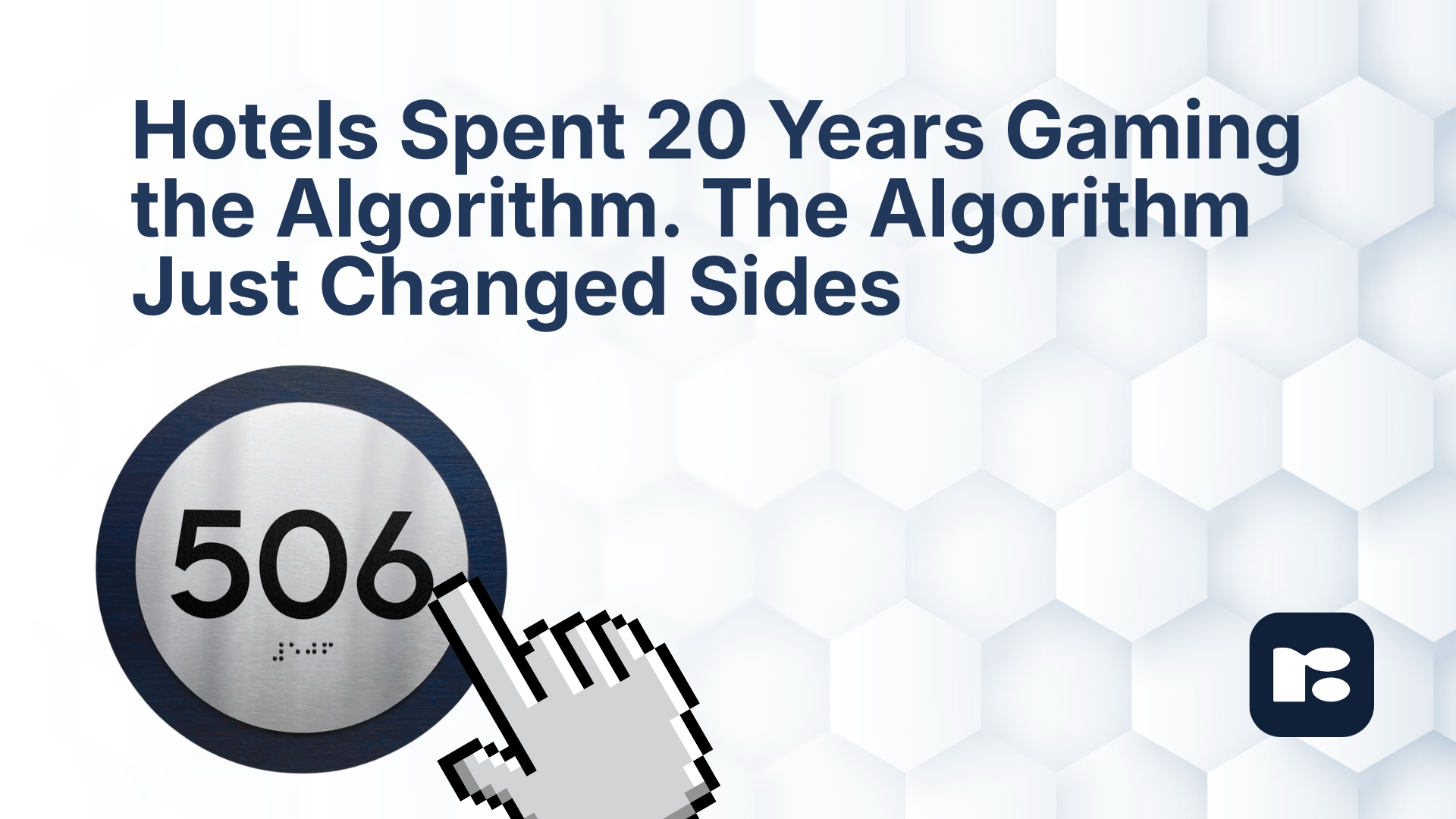
Hotels Spent 20 Years Gaming the Algorithm. The Algorithm Just Changed Sides
Google's May 2026 announcement at GML extended UCP, Universal Cart, and Agent Payments Protocol into hotel booking. The OTAs already signed on. What it means for hotels that have spent twenty years buying visibility instead of building room-level data, and what the next 18 months actually require.

TL;DR
-
On May 20, 2026, at Google Marketing Live, Google quietly announced the rules of the next decade of hotel distribution, not in a press release about hotels, but in a blog post about shopping. The announcement extends Google's Universal Commerce Protocol (UCP), Universal Cart, and Agent Payments Protocol (AP2) into hotel booking, with co-developing lodging partners Amadeus, Booking.com, Expedia Group, Hilton, Marriott, and Trip.com, and endorsing partners including Accor, Choice Hotels, IHG, and Wyndham. Soon, in Google's words, "people will be able to easily book their next hotel right from AI Mode in Search."
-
That sounds like a marketing tweak. It is not. It is the end of an era in which a hotel could buy its way to the top of a results page with a thicker commission, a Preferred Plus badge, and a stack of suspiciously glowing reviews. In an AI-mediated world, the algorithm is no longer seducing a human with a hero shot. It is matching a structured query to structured data on behalf of a guest who has delegated the choice.
-
The hotel industry, by and large, has neither the structured data nor the habit of telling the truth at the room level. That is a problem. It is also the most important opportunity hospitality has had in twenty years.
Key Findings
- Google's UCP plus AP2 stack now extends to hotels. Universal Cart, UCP, and AP2, plus the new Merchant Center "conversational attributes," explicitly target a world where AI agents, not humans, select and book hotel rooms. Lodging is the named first new vertical.
- Hotel distribution today is a commission auction wearing the costume of a search result. OTAs charge 15 to 30 percent commission and sell visibility on top of that. Booking.com's Preferred Plus tier costs roughly 23 percent commission for "up to 60% increased visibility."
- The data is broken at the unit that matters: the room. Hotels list "room types," not rooms. The "Standard King" abstraction hides everything an agent actually needs to make a fit decision.
- The review layer is structurally compromised. Tripadvisor blocked 2.7 million fake reviews in 2024; the FTC's Consumer Review Rule now imposes civil penalties of up to $53,088 per violation.
- Agents punish all of the above. Garbage data, paid-for visibility, and slop reviews don't degrade gracefully. They simply make a property invisible to a delegated agent operating on a signed Intent Mandate.
Details
What Google Actually Announced
Three building blocks, all interlocking, all aimed at the same thing: removing the human from the booking funnel.
Universal Cart, powered by UCP, is a persistent shopping cart that lives across Google Search, Gemini, YouTube, and Maps. A shopper, or their agent, can assemble items from multiple merchants and check out with Google Pay "in just a few taps," with the retailer remaining merchant of record. At launch, this is Nike, Sephora, Target, Ulta, Walmart, Wayfair, and Shopify merchants like Fenty and Steve Madden. Hotels and food delivery are next.
Universal Commerce Protocol (UCP) is the open standard that lets an agent, a merchant, and a payments provider speak to one another without bespoke integrations. UCP defines how the agent presents intent and how the merchant returns inventory, pricing, loyalty terms, and confirmation. Crucially, Google is rolling out a set of conversational attributes in Merchant Center: question-and-answer pairs, related products, document links, item-group titles, variant options, and popularity rank, all designed to let merchants describe products in the granular, conversational way agents actually query them. Per Google's own Merchant Center documentation, these attributes "help AI systems and conversational agents better understand your products' specific nuances" across "AI-driven surfaces, like AI Mode in Search."
Agent Payments Protocol (AP2), announced September 16, 2025 with 60-plus partners including Mastercard, American Express, PayPal, Adyen, and Coinbase, is the cryptographic layer underneath. AP2 represents each agent purchase as three signed mandates (Intent, Cart, and Payment) so the merchant and the network can verify that the user actually authorized this specific purchase, within these specific limits, before any money moves. Google's own example, written into the launch announcement:
Book me a round-trip flight and a hotel in Palm Springs for the first weekend of November, with a total budget of $700.
The agent negotiates with airline, hotel, and OTA agents simultaneously and executes both bookings against signed mandates.
Read those sentences again. The person never opens Booking.com. Never sees a Tripadvisor review. Never clicks an Expedia "best value" badge. The agent reads structured data and acts.
Vidhya Srinivasan, Google's VP and GM of Ads and Commerce, framed the shift bluntly in her 2026 annual letter:
In 2026, agentic commerce is no longer just a concept, it's reality. It will transform how we shop, from discovery to decision.
The transition, in her words to CNBC at the UCP launch, "addresses the newer consumer behavior which is shifted toward more conversational commerce."
The travelers are already there. Per Phocuswright's Travel Forward: Data, Insights & Trends for 2026 report:
As of the second half of 2025, 39 percent are using it for travel, utilizing tools like ChatGPT, Google Gemini, or AI-enabled search engines to research and plan their trips.
Phocuswright also reports that more than 60 percent of travel businesses are experimenting with or scaling agentic AI. In November 2025, Google publicly named Booking.com, Choice Hotels, Expedia, IHG, Marriott, and Wyndham as launch partners for agentic hotel booking inside AI Mode. The infrastructure is built. The merchants are signing.
The question is whether hotels are actually ready to be picked by a machine. Spoiler: they aren't.
The Three-Headed Problem: Payola, Dirty Data, and Review Slop
For two decades, hotel distribution has run on a simple, ugly principle: visibility is bought, not earned. That worked when the customer was a tired human scrolling on a phone, susceptible to a hero image and a yellow "Recommended" tag. It will not survive the agent.
1. Payola: Ranking by Commission, Not Fit
OTAs charge independent hotels 15 to 30 percent commission per booking, with effective rates approaching 30 to 40 percent once "preferred" placements and promotional spend are layered on (Cloudbeds, EHL Insights, 2024 to 2025). Booking.com's own Preferred Partner Program, open to the top 30 percent of partners who pay a higher commission, explicitly promises "up to 65% more page views and on average 20% more bookings." Preferred Plus, reserved for the top 10 percent of partners, costs roughly 23 percent commission and, per Booking.com's partner documentation, delivers "up to 60% increased visibility, which could lead to 30% more bookings compared to Preferred partners."
That is not a marketplace. That is a toll booth dressed up as a search result.
The Visibility Booster tool literally lets a property drag a slider to spend more commission in exchange for a higher rank on chosen dates. On Google Hotel Ads, hotels bid for placement via CPC or (formerly) commission-per-stay; the higher the bid, the higher the listing. Trivago, Kayak, and Tripadvisor's TripConnect operate similar mechanics.
The "billboard effect" Cornell professor Chris Anderson documented in 2009 and again in 2017, where 65 percent of direct bookers had first visited an OTA, is the friendliest possible framing of a system in which, per PhocusWire's analysis of full-year 2024 financials, the four largest OTAs collectively spent $17.8 billion on sales and marketing in 2024 (up roughly a billion from 2023) to insert themselves between hotels and guests, then charge the hotels for the privilege.
Booking Holdings alone reported $22 billion in revenue in 2024. OTAs captured 61 percent of bookings for independent properties that year (Phocuswright). In Europe, where Booking.com was designated a Digital Markets Act "gatekeeper" in 2024 and forced to drop wide and narrow rate-parity clauses, the European Court of Justice ruled in September 2024 that those clauses "are not objectively necessary" to the OTA's business model, a polite legal way of saying the king has no clothes. Spain's CNMC announced a €486 million fine against Booking.com the same year for restricting Spanish hotel pricing.
This is what the agent will see when it asks, "What hotel best fits my guest?" Not quality. Not fit. A commission auction.
2. Dirty Data: The "Standard King" Lie
Take the most evergreen hotel search there is: a hotel in Paris with a view of the Eiffel Tower.
You can find dozens of properties that advertise it. Some are entitled to it; their hero shot is a real room in their building with a real line of sight to the tower. Many are not. They have a room with that view, or one floor of rooms, or one corner of one floor, and they sell every other room in the building behind the same headline. The booking engine doesn't disambiguate. The OTA doesn't disambiguate. The guest sees the same listing, the same hero image, the same nightly rate.
I have a photograph from a Paris hotel I stayed in that explicitly advertised a landmark view. This is what mine actually looked like.

The room across the hall, on the same floor, in the same building, paying the same price, probably did get the view. That is the disconnect at the heart of every hotel booking that goes sideways. The property has the asset. You did not necessarily get the room with the asset. The data the booking engine reads cannot tell the two apart.
Generalized: hotels do not market rooms; they market room types. Every "Standard King" in a 400-room property is treated as identical for the purpose of OTA listing, channel-manager inventory, and PMS rate-loading. In reality, Room 412 has a sweeping park view and Room 413, same floor, same "type," sits twelve feet from an HVAC compressor that runs all night. The guest paying $279 has no way to know which one they will get. The OTA does not know. The metasearch engine does not know. The hotel knows, and chooses not to disclose, because room-type taxonomy is what its distribution stack supports.
The Elliott Advocacy consumer-complaint desk receives "frequent complaints from hotel guests whose rooms don't match the online description," in founder Christopher Elliott's words: photos taken at lenses no real room can replicate, square-meter claims that are actually square feet, "ocean view" rooms staring at parking lots, "fitness centers" that are two broken treadmills in a closet. OTAs disclaim responsibility ("booking platforms are not responsible for the accuracy of their hosts' listing descriptions," as one industry forum noted) and hotels know it. The information asymmetry is the business model.
This is precisely the problem AI agents are built to solve, and the problem hotel data infrastructure is not built to answer. As one Hospitality Net analysis put it in early 2026:
If an AI agent searches for "a quiet hotel with a co-working space and vegan breakfast," and your website data doesn't explicitly tag these attributes, you do not exist to the agent.
SiteMinder's AI-distribution guide is more blunt: "AI models rely on structured information like room types, amenities, policies, and images to decide which hotels to recommend. If this information is incomplete, inconsistent, or poorly presented, your property may be excluded."
There is no "Preferred Plus" workaround for an attribute you simply don't have.
3. Review Slop: The Trust the Industry Already Burned
Then there is the review layer, the one piece of "guest voice" in the funnel, and it is on fire.
In 2024, Tripadvisor flagged 2.7 million fake review submissions, roughly 8 percent of the 31.1 million reviews it received, and removed an additional 214,000 reviews suspected of being AI-generated, across 101,411 properties in 189 countries (Tripadvisor 2025 Transparency Report; CNBC, May 2025). Tripadvisor warned approximately 9,000 businesses about incentivizing customers or employees for positive reviews, and traced 360,000 removed reviews to employee-incentive programs alone. "Review boosting," in which owners, employees, and affiliates post positive reviews to lift rankings, accounted for 54 percent of all detected fraud. Independent fraud-detection firm Fakespot has previously estimated that more than one-third of online hotel reviews are "fake and unreliable," with cities like Miami running as high as 60 percent. A 2025 Transparency Company / Uberall study pegged the broader web average at roughly 30 percent.
Regulators noticed. On August 14, 2024, the U.S. Federal Trade Commission finalized 16 CFR Part 465, the Consumer Review Rule, effective October 21, 2024, explicitly banning fake reviews, paid-for-sentiment reviews, undisclosed insider reviews, review suppression, and AI-generated reviews that misrepresent experience. Civil penalties run up to $53,088 per violation. On December 22, 2025, the FTC issued its first enforcement warning letters to ten companies under the rule. The rule applies, in its plain language, to advertisers in any industry, including hospitality.
The cumulative effect: the most-trusted layer of pre-AI hotel discovery is also the most polluted. Tripadvisor's own head of trust and safety, Becky Foley, concedes the industry is in a "cat-and-mouse" arms race. And we are about to ask an AI agent to read those reviews on the guest's behalf? With a straight face?
Why the Old Game Breaks in an Agentic World
The hotel industry's distribution playbook was built around three assumptions, all of which Google's announcement just invalidated.
Assumption 1: A human eyeball is at the end of the funnel. Wrong. UCP and AP2 are explicitly designed for a future where the human delegates the search and the booking to an agent. McKinsey, citing Skift's State of Travel 2025, notes that only 2 percent of respondents say they are "currently willing to give an AI tool full autonomy to 'take the wheel'" on travel bookings. Expedia Group's "AI Trust Gap" report (commissioned by Expedia, conducted by YouGov across 5,700-plus adults in the U.S., U.K., and India, March 10 to 25, 2026) similarly found that "very few (8%) feel comfortable booking through an AI platform."
But the trust line is moving fast. Marriott Bonvoy's "2026 EMEA Ticket to Travel Report," conducted by Mortar across 22,000-plus adults in 11 markets (released October 24, 2025), quotes Marriott CCO Andrew Watson: "More than half of surveyed travellers in EMEA have already used AI to plan or research holidays, and 50 percent say they're open to using it to book accommodation in the future." Global Hotel Alliance EVP of Strategy Kristi Gole, presenting the 2026 GHA Travel Trends Survey to Skift on December 8, 2025: "Nearly two-thirds of our members have used a tool like ChatGPT to plan a trip, and four-fifths said they'd be comfortable using an AI-powered travel concierge." The infrastructure (UCP, AP2, AI Mode, Gemini) is being poured beneath the trust curve right now.
Assumption 2: Sponsored placement equals selection. Wrong. An agent operating under an AP2 Intent Mandate ("king bed, quiet floor, walking distance to convention center, under $290, free cancellation") does not care about your Preferred Plus badge. It cares whether your structured feed actually answers the question. Google's conversational attributes are explicit on this: the agent reads the attributes, not the ad spend. Phocuswright's 2026 Travel Forward report puts it plainly:
The prerequisite is clear: clean data. Most travel companies still need to modernize systems and feeds so agents can reason effectively.
Assumption 3: Hotel-level and room-type-level data are good enough. Catastrophically wrong. The unit of agentic commerce is the match between user intent and a specific bookable item. For a Sephora purchase, that's a SKU. For a Walmart cart, that's a UPC. For a hotel, that's a room, not a "room type," not a property. When an agent asks for "high floor, away from the elevator, quiet HVAC, work-from-here desk, real natural light," the hotel that can answer at the room level wins. The hotel that can only answer "Standard King, see attached photo of an idealized representation" loses.
This is the heart of it. The agent does not care about your brand story. It cares whether your data is accurate, structured, granular, and machine-readable. The decades-long habit of marketing to algorithms rather than to guests, of optimizing for ranking instead of fit, of obscuring true product details to preserve pricing power, of buying reviews to plump a star rating, of paying for visibility instead of earning it, was always a tax on guest trust. In an agent-mediated world, it becomes a structural disqualification.
Garbage in, garbage out. The agent will route the booking to whichever property has clean enough data to be confidently picked. Everyone else becomes invisible.
Recommendations
This is not a five-year transformation. Google's hotel UCP integration is rolling out "in the coming months." Booking.com and Expedia are already named co-developers. Marriott, Hilton, and the major OTAs are not waiting. The window for independent and mid-tier properties to catch up structurally is roughly the next 12 to 18 months.
1. Get to room-level truth, now. Audit your inventory at the room level, not the room-type level. Every key, every view, every quirk, every noise vector. Capture it as structured data, not as marketing copy. The "Standard King" abstraction is now a liability. If you don't know what you actually sell, the agent can't pick you.
2. Restructure your feed for conversational attributes, not keyword SEO. Google's Merchant Center now exposes attributes for FAQ-style Q&A, related items, variant options, popularity rank, and document links. Hospitality equivalents (accurate room-level photos with provenance, verified amenity tags, real square footage, real bed dimensions, real noise and view profiles, real accessibility data, granular policies) need to be fed into channel managers and exposed via MCP, A2A, and UCP-compatible interfaces. If your tech stack can't produce a machine-readable answer to "which room in this hotel is quietest after 10 p.m.," your stack is obsolete.
3. Stop paying to suppress the truth. The FTC Consumer Review Rule has made "review gating," incentivized reviews, and AI-generated review content financially radioactive: $53,088 per violation, with the first enforcement letters out December 2025. The defensible long game is a verified, guest-submitted, room-specific feedback layer that an AI agent can actually trust. Aggregated 4.3-star hotel ratings are now signal-poor and legally risky. Verified room-level ratings are signal-rich and defensible.
Benchmarks that should change the strategy:
- If AP2-mediated bookings exceed 5 percent of your inventory volume by Q4 2026, pay-to-play OTA visibility is officially in structural decline. Reallocate.
- If your top 10 percent of rooms by revenue can be identified at the key level (not the room-type level), you are ahead of 95 percent of the industry.
- If a guest complaint about "room didn't match the photos" cannot be traced to a specific image and a specific date in your system, you are not yet ready to defend a Consumer Review Rule complaint, much less compete with an agent that has memory.
Caveats
- Consumer trust in fully autonomous AI booking is still nascent. The 2 percent (Skift 2025) and 8 percent (Expedia / YouGov, April 2026) "comfortable letting AI book" figures are the floor, not the ceiling, but they are real today. Hotels should not assume the entire booking funnel will be agent-mediated by 2027. Plan for parallel human and agent paths through at least 2028.
- UCP, AP2, and AI Mode integrations for hotels are still rolling out. Google's GML 2026 announcement uses the language "in the coming months." Specifics on hotel-room data schema, room-level attribute standards, and metasearch ranking integration remain in flux. Vendor lock-in risk is real; protocol-level standardization (UCP being open) is the safer bet than any single proprietary integration.
- OTAs are not going away. They are signing onto UCP precisely so they can stay in the agent flow. The likely 2027 to 2028 picture is not "no OTAs" but "OTAs whose ranking now also depends on structured merchant data." That still strips much of the pure pay-to-play advantage, but hotels that abandon OTA channels entirely on the basis of this announcement are over-correcting.
- FTC enforcement of the Consumer Review Rule is still early. The first warning letters went out December 22, 2025, and no major hotel-specific enforcement action has yet been publicly announced. The legal risk is real and the penalty schedule is published; the enforcement cadence is not yet known.
- Source mix. Several supporting figures (commission rates, billboard-effect studies, review-fraud prevalence) draw on industry trade publications and vendor research (Cloudbeds, SiteMinder, EHL, PhocusWire, Phocuswright). Primary regulatory and corporate sources (FTC, ECJ, Booking.com partner docs, Google blog, Tripadvisor Transparency Report) anchor the most consequential claims.